Ethereum is undergoing a "major overhaul": is it a good opportunity to get on board, or a signal to escape?

 For a long-term bull market in the secondary market, only through meaningful trading volume and consolidation can price and value truly align.
Author: SoSo Value
The market has become elusive again.
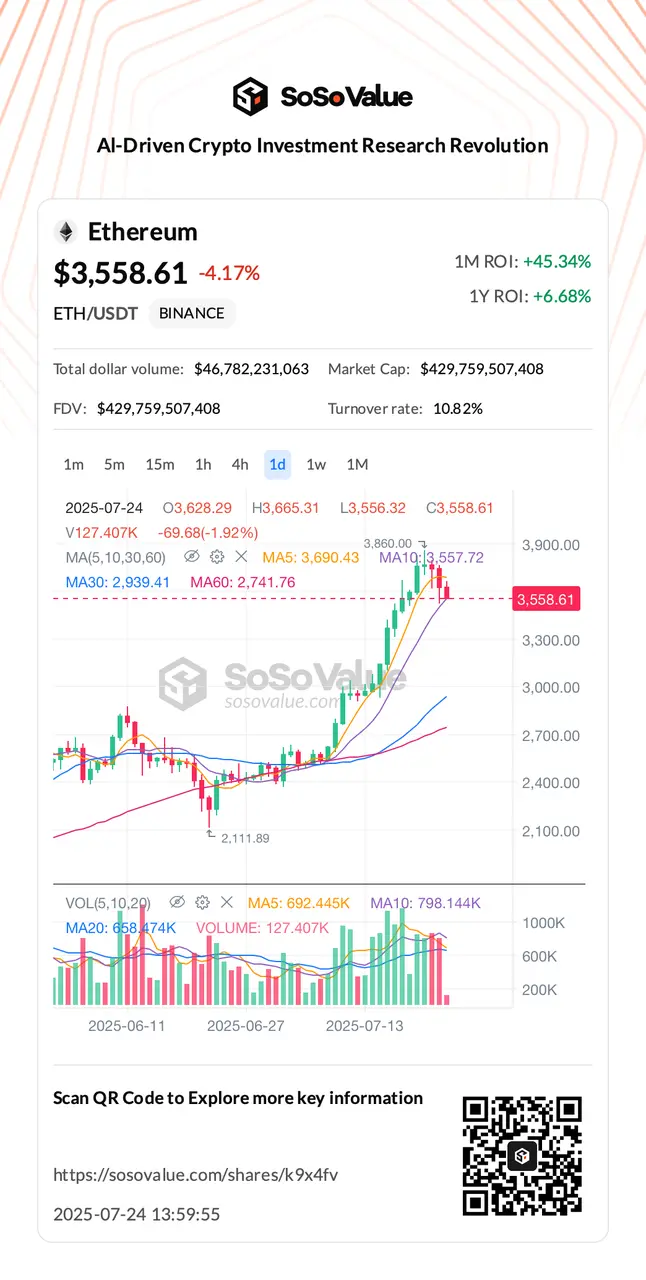
On one hand, the price of ETH has neither surged nor plummeted significantly, leaving investors restless; on the other hand, alarming news headlines keep appearing—"ETH worth $2.3 billion is queued for redemption, the largest selling pressure in history!" Panic spreads rapidly. It's like being in a theater where the lights start to flicker, and the audience in the front rows begins to leave one by one. You start to wonder, "Is this performance about to collapse? Should I exit too?"
But don’t rush. Before impulsively hitting the "sell" button, let’s calmly and carefully investigate the fundamental question: who is selling? More importantly, who is buying? Once you see the cards held by both sides, you will realize that this is not a panic-driven buying spree—rather, it is a reshuffling of a game that may determine the future.
Step 1: Sellers - Who is offloading ETH?
The recent large-scale selling pressure of ETH comes from three sources:
- Early investors cashing out profits: As ETH reached new highs, many long-term holders decided to realize their gains and reduce their positions.
- Large-scale redemption events from on-chain stakers: Since the Shapella upgrade allowed for more flexible ETH withdrawals, a significant amount of previously locked tokens has entered circulation, some of which have been sold.
- Institutions and whales reconfiguring at peaks: Some institutions and large accounts sold at recent highs, reallocating to other assets or engaging in speculative arbitrage.
- Major selling activities and key addresses
- In July 2025, a significant selling event occurred at the well-known institution Trend Research: within 24 hours, they sold 69,946 ETH (approximately $218 million), including a block sale of 21,000 ETH (about $67 million). Even after the sell-off, the Trend Research wallet still held 115,187 ETH, indicating this was a portfolio rebalancing or profit-taking rather than a "full-scale sell-off."
- Another major seller was a whale account (which sold 40,000 ETH, worth about $127 million, sent to Kraken exchange). In July, the total sales from institutions and whale accounts exceeded $374 million.
- The Ethereum Foundation was also suspected of selling, but clarified that part of the sale was actually conducted by the nonprofit Argot Collective, which supports Ethereum infrastructure, selling 1,210 ETH for development funds.
- Characteristics and process of the sell-off
- Most of the selling came from institutions and whales, representing a typical "one-time settlement" for profit-taking, rather than blind panic selling.
- Most of the sold ETH flowed to CEX (such as Kraken, Binance), with some quickly absorbed by new capital and ETF demand.
- The reality is that whales and institutional investors are buying and selling at both highs and lows, with one side taking profits and the other building long positions. Key insight: This round of redemptions is a normal phenomenon in the mid-cycle of a bull market, essentially optimizing and consolidating the investor structure.
Step 2: Who is buying? The new "pipeline" from Wall Street
As "old money" exits, who will become the new big buyers? The answer is: Wall Street—specifically, Ethereum spot ETFs.
If the cryptocurrency market is a pond, then Ethereum spot ETFs are like a newly constructed giant pipeline, directly connecting it to the ocean of global capital (traditional finance). Since their launch, U.S. spot Ethereum ETFs have attracted $8.32 billion in net inflows, currently holding over 4.4% of the circulating ETH supply. BlackRock's iShares Ethereum ETF (ETHA) alone holds over 2.2% of the total ETH supply.
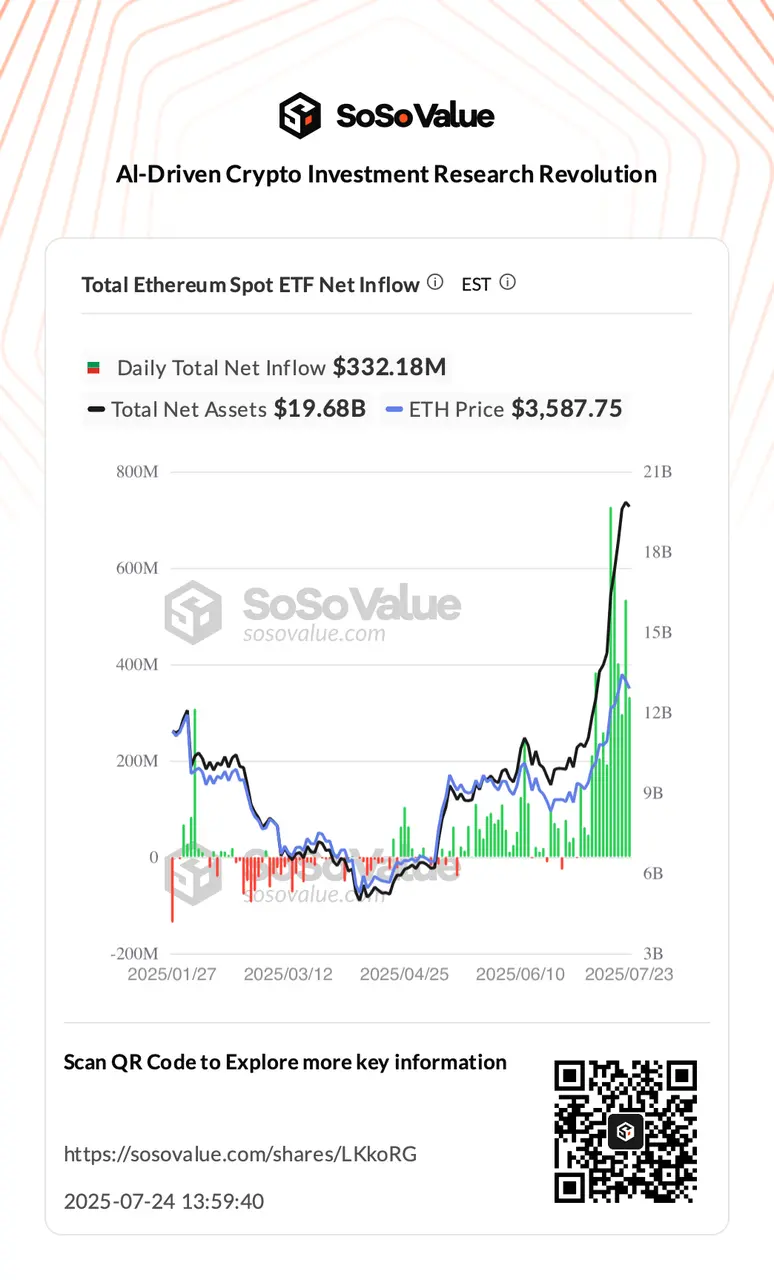
Statistics show that the fund flows into ETH ETFs are highly independent: even during market turmoil when Bitcoin ETFs experienced outflows, ETH ETFs steadily attracted inflows like a magnet.
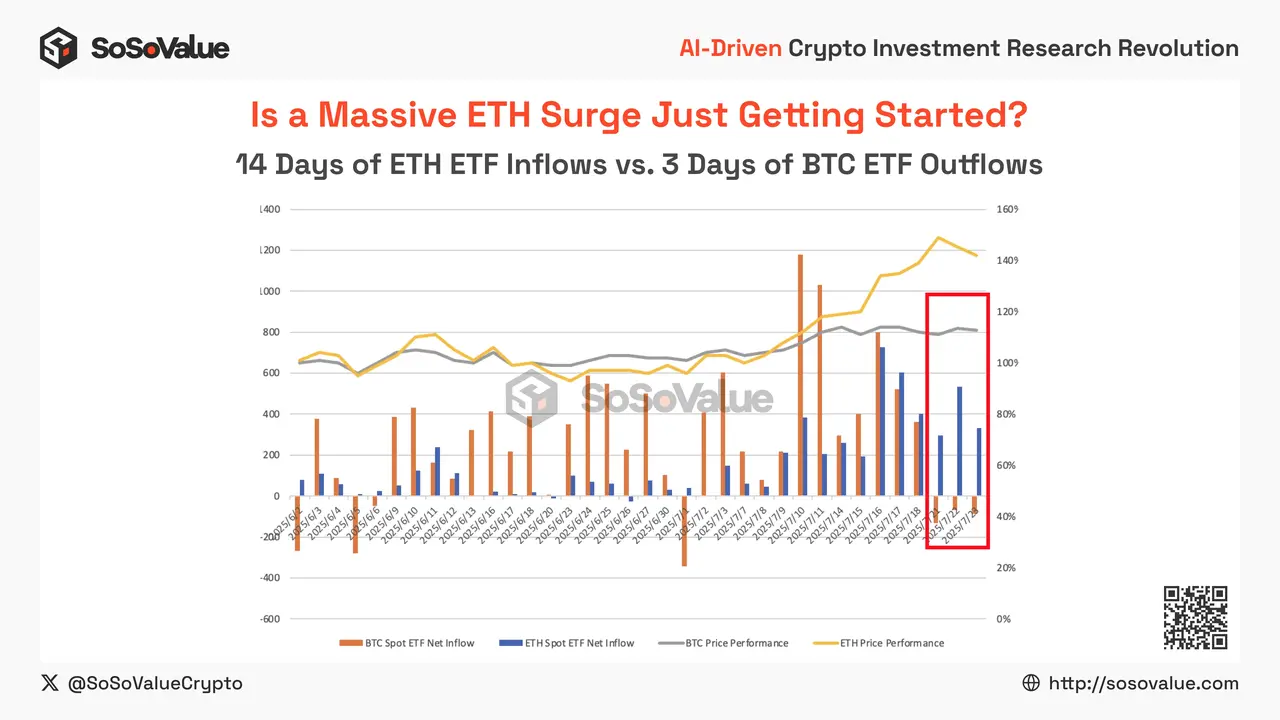
This divergence sends a strong signal: the investment flowing into ETH is not passive or trend-driven, but rather a thoughtfully considered strategic allocation.
Just as stock investors selectively buy the second-largest blue-chip stock (Ethereum) when the index leader (Bitcoin) fluctuates, institutions are recognizing ETH's unique value as "digital oil" and a decentralized platform.
Another major buying force driving ETH's rise comes from savvy public companies and institutional "whales." These investors no longer view ETH as a speculative trading tool but as a productive asset capable of generating returns, incorporating it into their balance sheets. Corporate CFOs now ask, "How much stable income can ETH bring me?" rather than "How high can the price go?"—marking a clear shift towards value investing.
When companies start converting part of their balance sheets into ETH, it signifies the industry's ultimate recognition of ETH's value. This is more meaningful than short-term speculation.
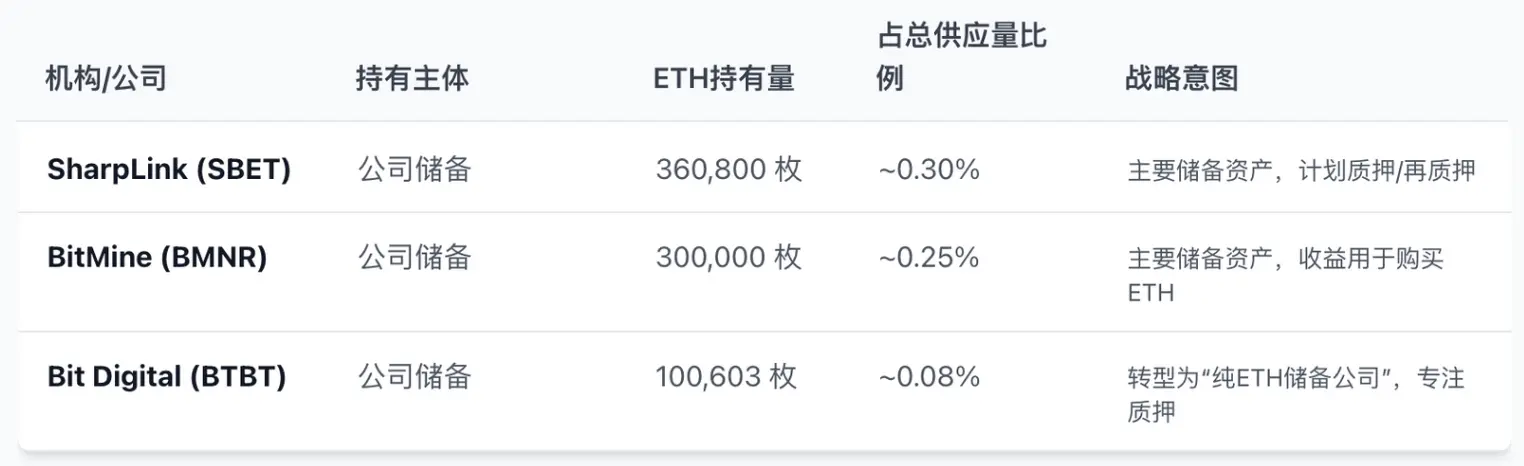
Key insight: Wall Street's "smart money" is establishing structural long positions through ETFs and fund companies. This influx of capital is stable, independent, and strong, forming a robust value support for ETH.
Step 3: Validator exit interpretation—changing of the "major shareholders"
The next clue lies in the core of the Ethereum network: validator dynamics. Recently, a record number of validators have joined the exit queue, raising concerns about a mass exit of core participants. But is this really a sign that "everyone is running"?
Let’s look at it from another angle. Imagine the hottest restaurant in town is always packed, with people waiting outside. When diners who ate early finish their meals and leave, freeing up tables, does that mean the restaurant is going out of business? Of course not; it simply means others finally have a chance to get in! The current changes in validators are akin to the "table turnover rate" of this popular restaurant.
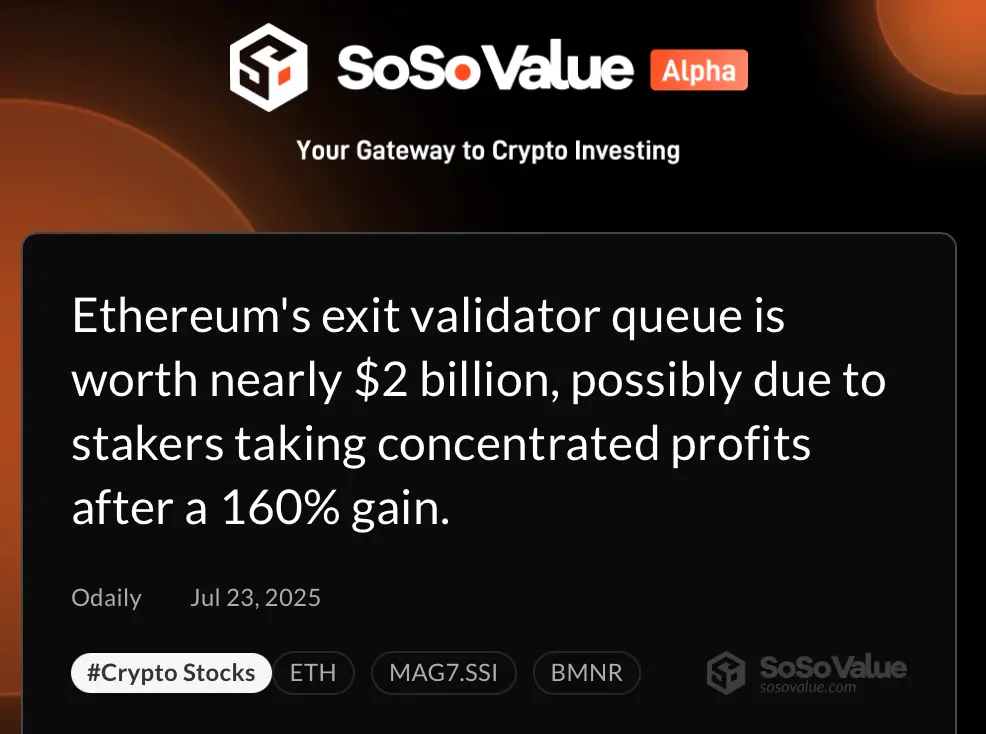
- As of July 23, approximately 519,000 ETH (about $1.92 billion) are queued to exit the network (the largest queue since January 2024), with withdrawal facing delays of over 9 days.
- Andy Cronk (co-founder of staking provider Figment): "When prices rise, people unstake and sell to lock in profits. We have seen retail and institutional investors repeat this behavior over multiple cycles." He further noted that large institutions changing custodians or wallet technologies could also trigger unstaking.
- Nevertheless, market pressure is not significant—demand for new validators joining is also strong, with 357,000 ETH (about $1.3 billion) waiting to join, and the waiting time for validators to join the queue has reached the longest since April 2024 (6 days).
- Some of the new demand may come from the ETH treasury fund; the U.S. Securities and Exchange Commission clarified that staking is not illegal, further stimulating institutional interest.
- Since late May, the number of active validators has increased by 54,000, reaching a record of nearly 1.1 million.
"Exits" (validators in the withdrawal queue): Mainly early investors or venture capitalists locking in profits after years of investment—planned "returns on investment," rather than panic selling.
"Entries" (validators in the activation queue): 357,000 ETH are queued to join—new, committed long-term capital wants to "take the baton," holding an optimistic view of Ethereum's future.
Key insight: This is not a one-way "run," but a healthy handover of shareholders. Short-term speculators are transferring their chips to long-term value investors, optimizing network participation and laying a more solid foundation for Ethereum's next phase of growth.
In-depth exploration: The three engines of ETH's value
Engine One: The value magic of the deflationary mechanism
Since the EIP-1559 upgrade, a portion of the base fee for each transaction is automatically burned. With the surge in network activity, the amount of ETH burned has exceeded the issuance, leading to ETH becoming deflationary, with a continuously decreasing supply. Unlike fiat currencies (where issuance can easily spiral out of control) and Bitcoin (with a fixed cap), ETH's deflation creates a stronger value anchor. The community jokingly refers to it as "ultrasound money": the scarcity of ETH is increasing, while the purchasing power and value storage capacity of each ETH are enhancing.
Engine Two: On-chain staking—economic "long-term bonds"
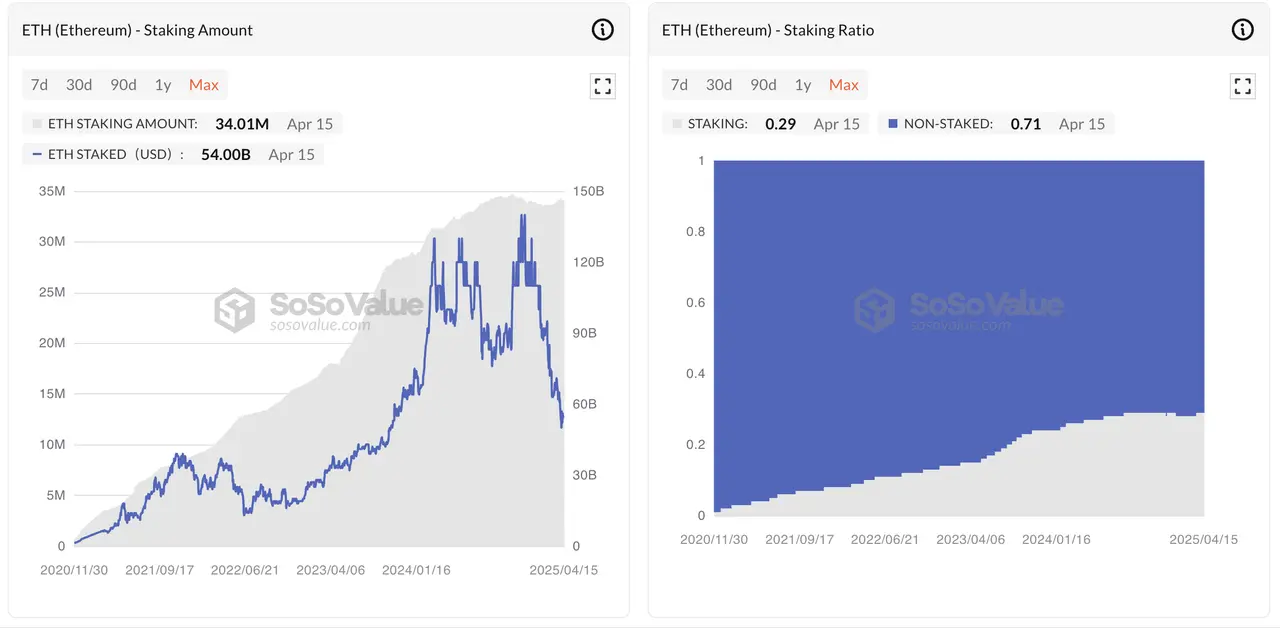
Each staked ETH acts like a long-term government bond—locked to secure the network and paying generous "interest" (staking rewards). Currently, over 34 million ETH are staked (accounting for about 29% of the total supply), meaning nearly one-third of ETH constitutes the backbone of the Ethereum economy.
- Since the Shapella upgrade enabled flexible withdrawal features, the net staking amount has increased by over 12 million ETH, demonstrating strong long-term confidence.
- Staked ETH not only earns rewards but also reduces circulating supply and sets a price floor for ETH.
Engine Three: Regulatory tailwinds attracting stablecoin flows and on-chain growth
The introduction of the U.S. Stablecoin Regulatory Act (GENIUS Act) has prompted numerous financial and tech giants to announce new stablecoin plans, sparking a "stablecoin race." The total market capitalization of stablecoins has recently reached $244 billion, with the Ethereum ecosystem accounting for 54%.
As stablecoins flow into Ethereum, it’s like giant "new ships" bringing real-world cash into the blockchain economy. This will drive the development of the on-chain DeFi market, increase gas fee consumption, and create sustained demand for ETH (for transaction fees and staking).
Risk Assessment: Not all smooth sailing
Despite the bright prospects, we must realistically assess the risks and challenges:
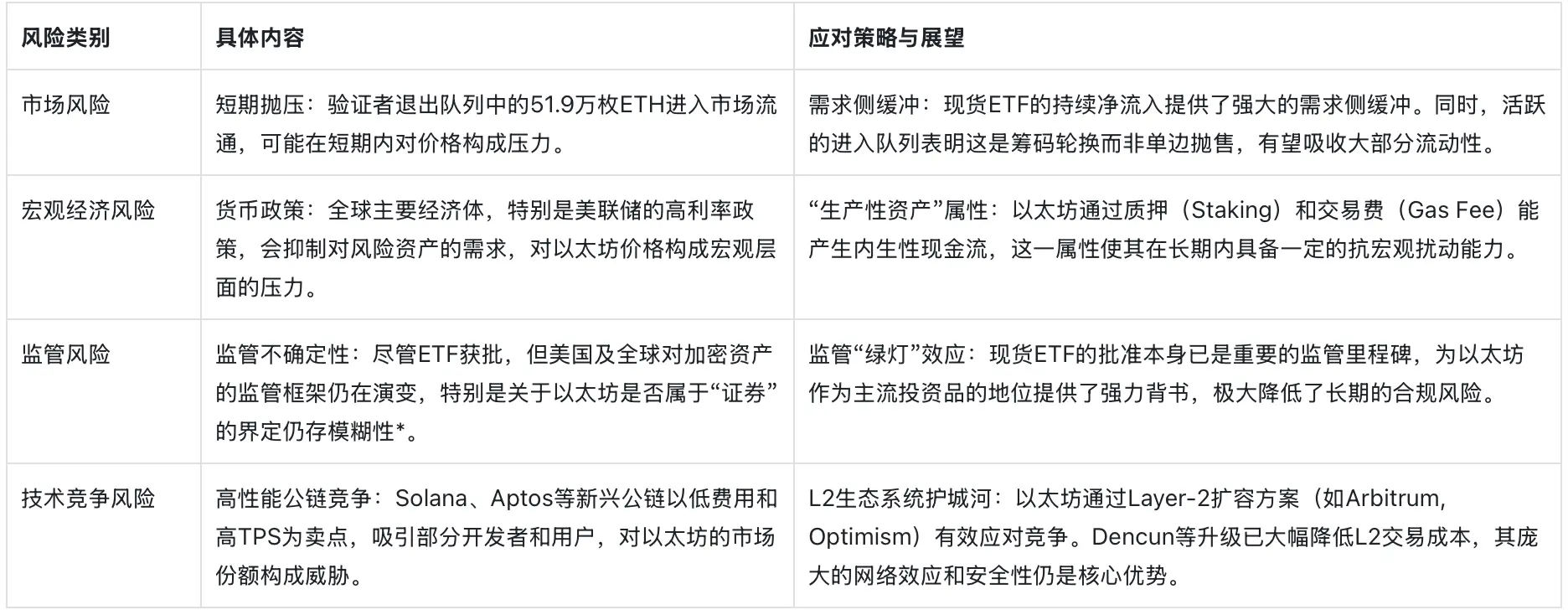
*ETH itself is classified as a commodity; there are still disputes regarding certain staking/derivative products, but the regulatory environment is becoming clearer.
Conclusion: Navigating uncertainty
Beneath the surface "ice layer" (price volatility, exits), the "flame" of Ethereum—driven by structural purchases and capital reallocation from ETFs—is burning brightly. This "major restructuring" is not a sign of decline but a revival of a healthier, stronger ecosystem.
The conclusion is clear: For investors who can see through the fog and identify structural trends, today’s market turbulence is not a "run for your life" situation, but a strategic buying opportunity. For a long-term bull market in the secondary market, only through meaningful trading volume and consolidation can price and value truly align.
The real question for investors is: How much time, confidence, and patience are you prepared to invest in this journey?
This article is a submission and does not represent the views of ChainCatcher, nor does it constitute investment advice.
 Risk warning
 Risk warning