In-depth analysis of OpenAI Pre-IPO

 OpenAI's 1.3 billion monthly active users and trillion-dollar advertising potential are creating a valuation space of trillions. The only no-threshold entry channel for retail investors, Bitget preOAI ($725), is now online, allowing early access to the wealth dividends from the IPO of top AI giants.
- OpenAI's 1.3 billion MAU is forming the most valuable consumer entry point in human history—users actively open it every day, deeply embed it into their workflows, and the switching costs are extremely high. The current $898B valuation only reflects the extrapolation of subscription + API "visible revenue," while new advertising revenue lines (projected at $25B in 2029), C-end platform repricing, and the GPT-6 re-rating effect have not been fully priced in. Bitget preOAI entered at $725/share, which is currently the only channel in the retail market that does not require accredited investor qualifications to participate, directly linked to public market prices after the IPO.
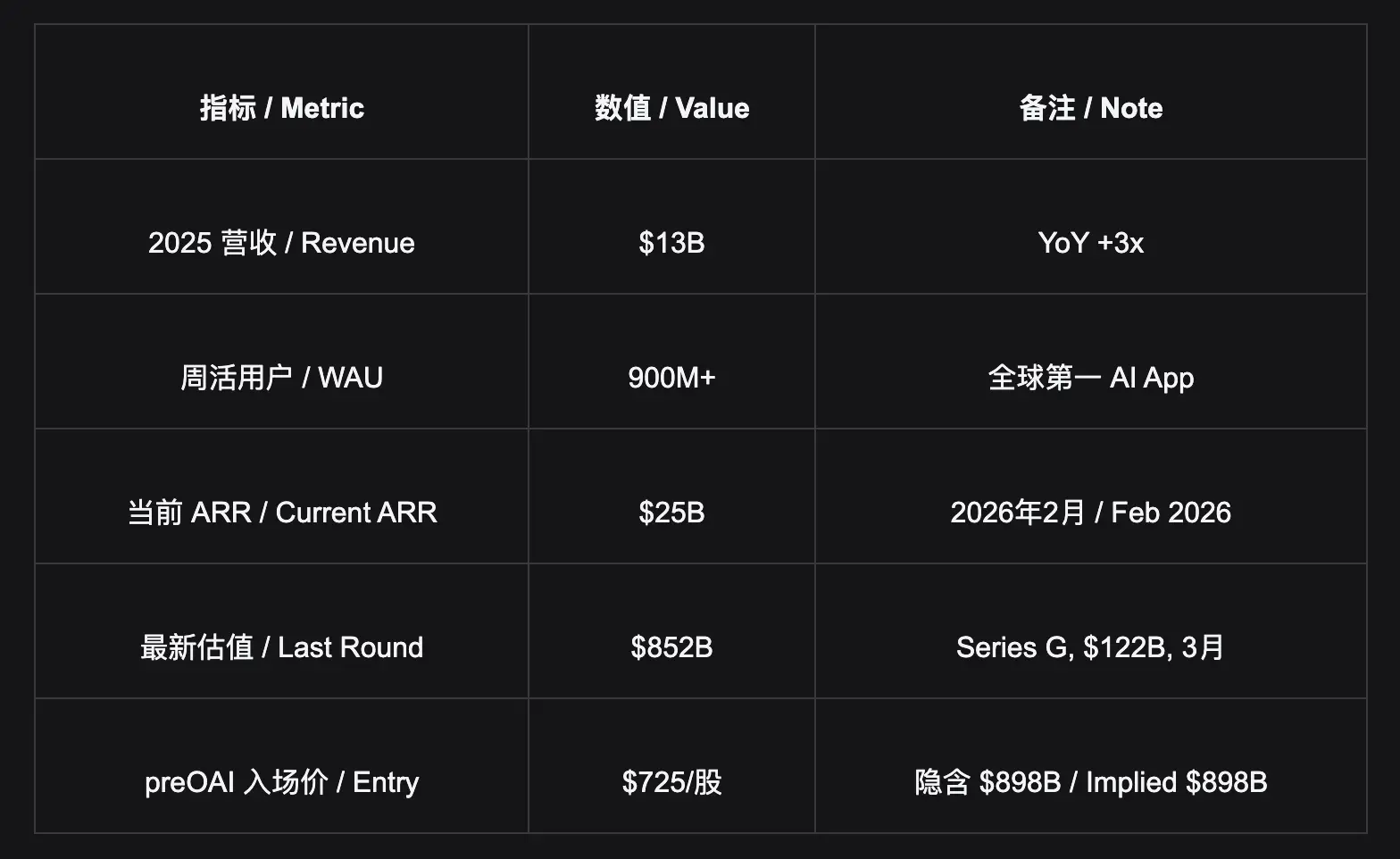
What is OpenAI: A three-tier revenue model, an actively opened consumer empire
OpenAI's business cannot be understood through the single framework of "AI company." It is simultaneously a consumer subscription platform (ChatGPT, 900 million WAU), developer infrastructure (API, relied on by millions of developers), an enterprise software company (Enterprise, contributing over 40% of revenue), and an emerging advertising and e-commerce platform—these four identities form a vertical closed loop centered around consumer entry.
ChatGPT is an app that users actively open, not a feature embedded in someone else's product. This is fundamentally different from Google Gemini (which relies on search/all-in-one distribution) and Anthropic (purely API). The behavior of 1.3 billion MAU actively opening it every day constitutes the most difficult-to-replicate distribution moat in the AI field to date.
Switching costs are not just about changing an app, but about cognitive restructuring. A user who "actively seeks answers" from ChatGPT every day incurs a much higher cost of behavioral pattern restructuring than switching streaming platforms. This habit moat historically belongs to only a few platforms: Google Search, iPhone, WeChat—they all share the characteristic of eventually entering the trillion-dollar valuation club.
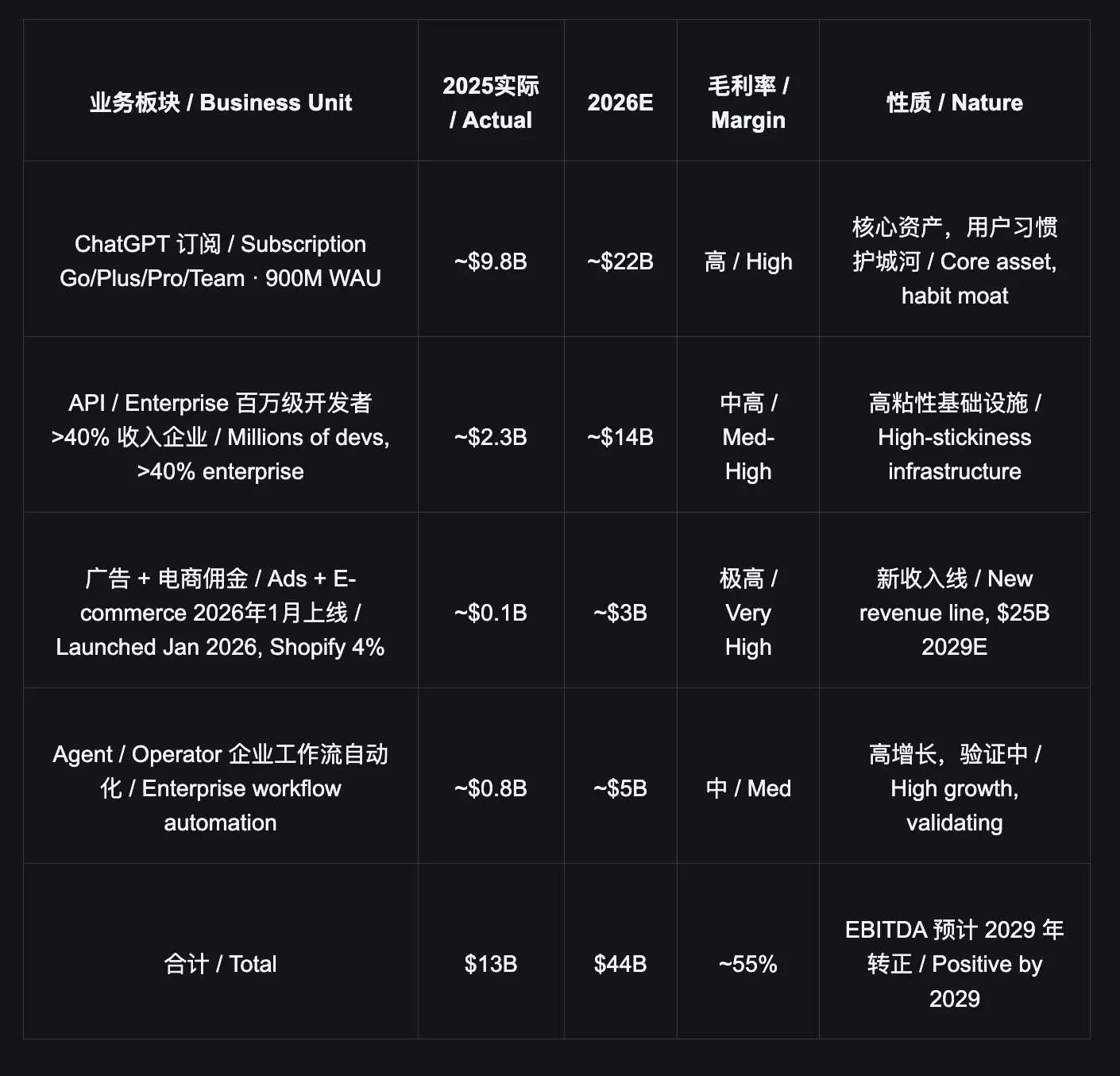
Why OpenAI is worth over $1T in the short term and close to $2T in the long term
Short-term catalysts
The current benchmark landscape of frontier AI remains fragmented: different models have advantages in dimensions such as knowledge work, scientific reasoning, coding, and multimodal generation. The core concern in the market recently has been whether OpenAI is losing the narrative premium of "absolute technological leadership."
However, this narrative is being rewritten. OpenAI has released GPT-5.5, officially positioned as its "smartest model yet," enhancing capabilities for complex tasks such as coding, research, and data analysis; more critically, the performance of Image2 / ChatGPT Images 2.0 has significantly exceeded market expectations, creating a strong user-side perceptual difference in image generation, editing, text rendering, multilingual support, and practical creative scenarios.
GPT-5.5 + Image2 is already sufficient to constitute a new product cycle: on one hand, it repairs the market narrative of "OpenAI's technological leadership being caught up," and on the other hand, it drives consumer engagement, enterprise budget return, and high-price subscription conversion through stronger multimodal capabilities.
1. GPT-5.5 Released: Repairing the Narrative of Technological Leadership
The significance of GPT-5.5 is not just a routine model upgrade, but a direct response from OpenAI to the narrative of "leading advantage being eroded by Gemini / Claude" over the past year. The official emphasis on GPT-5.5's enhancements in complex tasks, research, coding, and data analysis indicates that OpenAI still maintains strength in core knowledge work scenarios.
Image2 exceeded expectations: the enhancement of image generation and editing capabilities is more easily perceived by ordinary users than pure text benchmarks and is more likely to spread on social platforms. Image2 may become the core trigger for accelerating the current ChatGPT WAU.
2. Media Cycle Explosion → WAU Continues to Rise
When GPT-4 was released, ChatGPT's DAU surged tenfold within a week. GPT-5.5 enhances high-tier user retention, while Image2 drives ordinary user return, and the combination of both is expected to push ChatGPT's active users further upward.
3. Enterprise Budgets Re-concentrating Back to OpenAI
GPT-5.5 covers professional workflows in research, coding, and data analysis, while Image2 covers marketing, design, e-commerce, and content production scenarios. OpenAI's platform attributes are further strengthened, giving enterprises more reason to re-concentrate their dispersed AI budgets back to OpenAI.
4. Free/Plus → Pro ($200/month) Upgrade Acceleration
The leap in model capabilities is the strongest driver for users to upgrade to paid subscriptions. Each additional 1 million Pro users = an annualized $2.4 billion ARR increment. If GPT-6 is released in the coming months and achieves comprehensive leadership, it will further reinforce OpenAI's "first" narrative before the IPO.
5. IPO Roadshow Valuation Adjustment → Q4 2026 $1T Target
OpenAI's capital market story has upgraded from "waiting for GPT-6 to regain leadership" to "GPT-5.5 / Image2 has already proven the product cycle restart, and GPT-6 is additional upside." This is more robust than simply betting on future model releases and is easier to support a higher valuation range.
Long-term Bullish · Long-Term Bull · C-end Super Platform / Consumer Super-Platform
OpenAI is not just an AI company; it is becoming "the default interface for human interaction with information and tasks." This position has only been reached by a few products in history: Google Search, iPhone, WeChat—they all share the characteristic of eventually entering the trillion-dollar valuation club.
- ARPU Comparison: Monetization space is complete. OpenAI's current blended ARPU is about $1.5/month ($25B ARR / 1.3 billion MAU); Netflix $15/month; Microsoft 365 $10-25/month; Spotify $10/month; Instagram ads global average $3.3/month. The depth and frequency of ChatGPT usage are not lower than any subscription product, but monetization is only 1/10 of Netflix. This gap is not a ceiling; it is space.
Advertising Business: An Overlooked New Revenue Line. Advertising testing launched in January 2026, fully promoted to U.S. users in February. Internal forecasts project 2026 advertising ARR at $1B, reaching $25B by 2029. The Shopify alliance has successfully closed the loop: in-chat shopping achieved over $100 million ARR within six weeks, taking a 4% commission. With 900 million WAU of advertising inventory, the implied value exceeds $300B when converted at Facebook's global average. This revenue line was hardly modeled into the $898B valuation.
Segment Valuation: $898B is below intrinsic value
Based on the expected financial data for 2026, the goal is to assess whether the Bitget preOAI entry price of $725 is within a reasonable range and where the upside potential comes from.
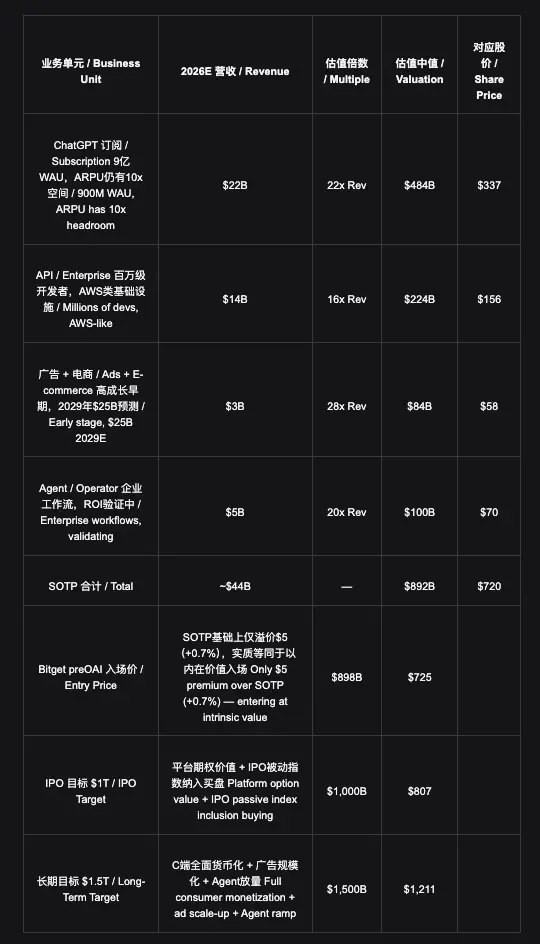
- Core Pricing Conclusion: The $725 entry price is almost on par with the SOTP median of $720—indicating that you are entering at a price close to "only based on visible business," while the $300B+ implied option value of the advertising business, AGI option value, and the repricing of C-end platform consumer premiums have not yet been accounted for. The $898B valuation is not overvalued; it underestimates the new revenue curve.
Pre-IPO Entry: Channel Comparison and Pricing Analysis
OpenAI is a private company, and ordinary investors cannot directly purchase its equity through any public market. The core fact: Series G institutional round equivalent share price is $687.7 ($852B valuation), with a minimum subscription threshold of $100 million—individual investors, regardless of asset size, cannot participate at this scale. Bitget preOAI at $725/share corresponds to the current latest market valuation of $898B, making it the only accessible channel in the retail market with secondary market liquidity.
Entry Channel Comparison / Access Channel Comparison
Series G · $687.7
Institutional Round · Closed
Implied $852B · Closed · Min $100M
To IPO Low End +17.3%
To LT Target $1.5T +76.1%
SoftBank led with $122B, minimum $100 million, only large institutions can participate. Institutional cost price is $687.7 ($852B), while the current preOAI at $725 corresponds to the latest $898B pricing—indicating that the market has repriced OpenAI, with institutions already in profit by 5.4%.
Hiive · $608
Real Equity · Accredited Only
Implied $873B · Secondary Transfer
To IPO Low End +32.7%
To LT Target $1.5T +99.2%
Must meet accredited investor qualifications (net worth ≥ $1 million) and a minimum subscription of $25,000. Private equity transfer, no secondary market, transfer cycles measured in weeks—catalytic events cannot respond in real-time.
preOAI · $725
Bitget IPO Prime · Tokenized · Only Tradeable
$898B · Latest Market Price · No Accreditation Required
To IPO Low End +11.3%
To LT Target $1.5T +67.0%
The only channel with secondary market access. Tokenized structure, no accredited investor requirements, no minimum amount restrictions. Can be bought and sold at any time—catalytic events like GPT-6 release, IPO announcements can be traded in real-time. Settlement after the IPO is directly linked to OpenAI's public market price.
- Liquidity is the core difference: preOAI is a tokenized product with a secondary market, allowing for buying and selling at any time—direct trading on price catalysts can occur within weeks of the GPT-6 release. Hiive is a private equity transfer with no secondary market, unable to respond to catalytic events; the institutional round also lacks an exit path. The preOAI price of $725 is about 5.4% higher than the institutional round price of $687.7, corresponding to the current latest $898B market valuation—reflecting the market's latest consensus on OpenAI's value.
Scenario Analysis and Key Assumptions
Scenario Analysis / Scenario Analysis
Bear Case $475---$550 $682B --- $790B
GPT-6 underperforms; Gemini massively erodes market share; advertising monetization harms user trust; IPO pricing at a discount. From preOAI $725, this translates to a downside of approximately -12% to -24%. The 1.3 billion MAU of ChatGPT provides bottom support.
Base Case (Primary) $807---$928 $1T --- $1.15T
GPT-6 rebuilds leadership, IPO in Q4 2026 priced at $1T, advertising gradually scales, with 2026E revenue of $44-50B realized as expected. From preOAI $725, this translates to an upside of approximately +11% to +28%, visible within 12 months.
Bull Case $1,000---$1,200 $1.44T --- $1.72T
GPT-6 establishes generational leadership, Agent enterprise ROI proves and accelerates volume, IPO oversubscribed, advertising reaches $25B by 2029 ahead of schedule. From preOAI $725, this translates to an upside of approximately +60% to +92%.
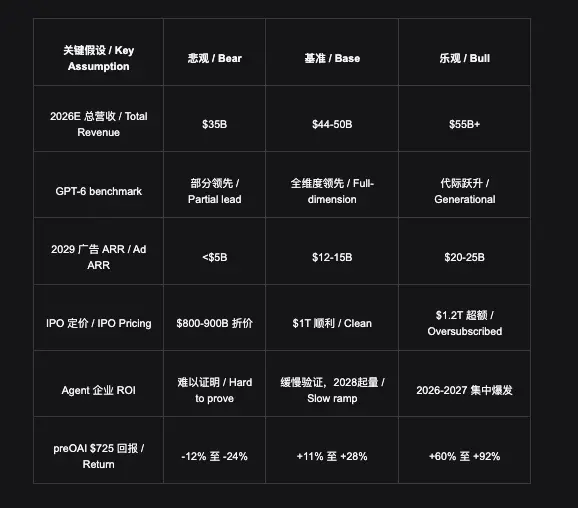
※ Major downside risks: ① Google Gemini achieves large-scale overtaking through all-in-one distribution (20% probability); ② Advertising monetization harms user trust leading to WAU shrinkage (10%); ③ Agent delivery delays affect enterprise renewals (15%); ④ Governance disputes (10%). The independent occurrence of these risks has limited impact; bottom support: the user habit moat of ChatGPT's 1.3 billion MAU will not collapse.
LLM Competitive Landscape: Strategic Differentiation and Long-Term Coexistence of the Big Three
The competition at the large model layer is not a zero-sum game but a coexistence of multiple oligopolies—each company's core user pool is almost non-overlapping. OpenAI's 1.3 billion active users, Anthropic's 1-2 million high-paying developers, and Google's 3 billion all-in-one ecosystem users represent three different infrastructure models in the AI era.
Competitive Landscape / Competitive Landscape
OpenAI
$852B (Institutional Round)
▸ Core Strengths
1.3 billion MAU consumer entry, actively opened, habit moat; the only entity capable of financing at a "national scale"; bottom-up culture allows for leaps in genius.
▸ Core Challenges
Coding has been taken by Anthropic; over 300 internal projects, execution is dispersed; high traffic on the C-end brings pre-training burdens.
▸ Long-Term Ceiling
$1.5T+ (Consumer Platform Grade)
Anthropic
Old shares implied at ~$800B, next round expected at $800-850B.
▸ Core Strengths
Abandoning C-end All-in Coding, organizational execution power is a moat; 1-2 million core developers generate revenue exceeding OpenAI's 50 million C-end subscriptions; API transitioning to Agent OS.
▸ Core Challenges
No consumer platform, ceiling is "the best developer tool" rather than "the largest consumer platform."
▸ Long-Term Ceiling
$1.5T+ (Developer OS Grade)
Google / Gemini
Alphabet $2T (AI upside not separately priced)
▸ Core Strengths
Sufficient computing power, most data, unparalleled distribution capability (3 billion+ ecosystem users); complete advertising infrastructure.
▸ Core Challenges
Benchmark is inflated, coding lags by 3-4 months; complex internal politics, lack of PM culture; always chasing, always half a step behind.
▸ End-Game Prediction
Each gets what they need, Google excels in distribution, OpenAI excels in active entry.
- Core Judgment: OpenAI and Anthropic will both be $1.5 trillion-level companies in the long term. Different paths, similar endpoints—OpenAI follows the consumer platform path (like Apple/Google), while Anthropic follows the developer OS path (like AWS). The core user pools targeted by the two companies are almost non-overlapping; this is not a zero-sum game but a parallel evolution of two dominant infrastructure models in the AI era. However, OpenAI's consumer platform premium has not been fully priced by the market—this is the core argument for the $725 entry point and a structural mispricing compared to Anthropic.
Disclaimer
This report is for internal research reference only and does not constitute investment advice. Tokenized products (preOAI) do not confer shareholder rights, have no voting rights, no dividend rights, and economic returns are linked to a reference index, with the settlement mechanism relying on platform credit. Private equity (Hiive) is limited to accredited/qualified investors, with fees of 3-5%, and lock-up periods depending on the holding structure. OpenAI's S-1 is in preparation, and IPO valuation, timing, and issuance structure may change. Financial forecasts are analyst estimates and not officially disclosed by OpenAI.
OpenAI --- $122B financing announcement · CNBC --- Series G $852B · Sacra --- OpenAI Equity Research 2026 · Business of Apps --- ChatGPT Statistics 2026 · Hiive --- OpenAI $608.06 (April 2026) · Polymarket --- GPT-6 Release Odds · IndexBox --- OpenAI IPO $1T Target 2026 · ALM Corp --- ChatGPT Ads $25B 2029 Projection
 Risk warning