Hu Jie guest at Huobi's Celebrity Lecture: The logic of the Federal Reserve's policy is changing, and Bitcoin will face new macro challenges

 The future direction of digital finance development is already very clear, as major economies around the world will continue to explore new paths for the integration of digital assets and traditional finance, while the advancement of institutional construction in the United States will further accelerate this process.
The global financial market may be at the starting point of a new round of monetary policy cycles.
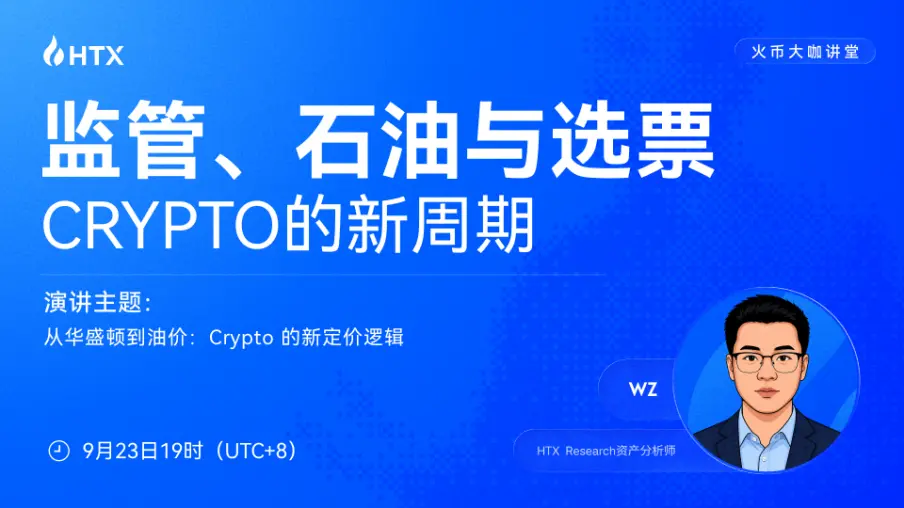
On June 25, Hu Jie, former senior economist at the Federal Reserve and professor at Shanghai Jiao Tong University's Shanghai Advanced Institute of Finance, was a guest at the fourth session of the Huobi Expert Forum. The theme was "From Wall Street to Web3: How Will the New Chair of the Federal Reserve Reshape the Global Financial Market?" He conducted a systematic sharing around the evolution of the Federal Reserve's monetary policy paradigm, the global liquidity cycle, the correlation between U.S. stocks and Bitcoin, as well as the regulation of digital assets in the U.S.

Hu Jie believes that to understand future market trends, one must not only focus on interest rate cuts or hikes but also pay attention to whether the underlying paradigm of the Federal Reserve's monetary policy is changing, as this will become an important variable in global asset pricing in the coming years.
Changes in the Federal Reserve's Policy Paradigm Have Been a Major Driver of the Global Asset Bull Market Over the Past 18 Years
Hu Jie believes that to understand the current global capital market, one must first understand the fundamental changes in the Federal Reserve's monetary policy after the 2008 financial crisis. He stated that over the past eighteen years, the continuous rise of U.S. stocks and global risk assets is not merely the result of improved corporate earnings or technological innovation; more importantly, the paradigm of the Federal Reserve's monetary policy has changed.
"After 2008, the bull market in U.S. stocks and other financial markets is largely due to the Federal Reserve switching its monetary policy paradigm, relying more on the issuance of base money to regulate the money supply. This paradigm shift has profound implications, affecting not only U.S. stocks but also the prices of Web3 assets like Bitcoin."
Hu Jie further explained that quantitative easing has not significantly raised long-term inflation but has changed the distribution structure of base money within the financial system, with a large amount of liquidity ultimately flowing into the asset market.
The New Chair of the Federal Reserve May Push for Another Shift in Monetary Policy
Regarding the newly appointed Federal Reserve Chair Kevin Warsh, Hu Jie believes that his biggest characteristic is a tendency to reduce reliance on the balance sheet, and the Federal Reserve may return to a policy framework primarily based on interest rate tools in the future.
"Since the new chair took office this year, it is clear that a paradigm shift is necessary. One of the most important things is to reduce the balance sheet, which means a decrease in the supply of base money."
However, he believes that the advancement of new policies will not happen overnight. Current geopolitical risks, energy prices, and inflation trends still have significant uncertainties, and the Federal Reserve needs to balance market stability, so the pace of balance sheet reduction will be more cautious. "The reduction of the balance sheet is likely to restart, but the pace is very important. If the pace is managed well, it may not necessarily cause huge negative effects."
Liquidity Remains an Important Variable Affecting Bitcoin
For the Web3 market, Hu Jie stated that Bitcoin is increasingly integrated into the global financial system, and its price performance is closely related to global liquidity. Especially in the past decade, Bitcoin's price has shown a strong positive correlation with the Nasdaq index, with a correlation coefficient as high as 77%. In the long run, Bitcoin is driven by macro factors similar to those affecting traditional tech stocks, such as liquidity.
He emphasized that the reduction of the balance sheet does not mean that the bull market will end immediately, but it does mean that the asset market will lose the liquidity support it has continuously received over the past decade.
"As a single factor, the reduction of the balance sheet is certainly unfavorable to any asset market, including U.S. stocks and Bitcoin. But it is not the only factor; the development of AI, strong fundamentals, and market sentiment may continue to support asset prices."
He believes that for investors, rather than focusing daily on interest rate cut expectations, it is more worthwhile to pay long-term attention to changes in global liquidity. "Liquidity is still the ammunition. Among all the factors affecting asset prices, liquidity is clearly a particularly critical factor."
Tokenization of U.S. Stocks Will Accelerate the Integration of Wall Street and Web3
Regarding the recent rise in the tokenization of U.S. stocks, Hu Jie believes that this is an important manifestation of the deep integration of traditional finance and Web3.
"The boundaries are definitely becoming blurred. Wall Street is entering Web3, and Web3 is increasingly linked with Wall Street; this is an inevitable trend."
He stated that in the short term, the tokenization of U.S. stocks may divert some funds from the crypto market, but in the long term, its real significance lies in opening up channels for traditional capital to enter the on-chain market.
However, he also reminded that RWA enhances trading efficiency, not the asset value itself. "Do not fantasize that a bad asset will become a good asset just by being packaged through RWA. Quality assets remain quality assets, and poor assets remain poor assets."
U.S. Digital Asset Legislation Has Global Demonstrative Significance
In conclusion, Hu Jie also focused on interpreting the digital asset regulatory legislation that the U.S. is promoting.
He believes that the CLARITY Act will definitely pass, and it won't take long, likely this year. He stated that the institutional construction around digital assets in the U.S. not only signifies its formal establishment of a global digital financial competition strategy but will also provide important references for global digital asset regulatory practices, including those in China.
Hu Jie believes that the future direction of digital finance is already very clear, and major global economies will continue to explore new paths for the integration of digital assets and traditional finance, while the advancement of U.S. institutional construction will further accelerate this process.
As a long-term knowledge-sharing program created by Huobi HTX, the Huobi HTX Expert Forum continues to invite authoritative experts from the global finance, technology, and Web3 fields to conduct in-depth sharing on cutting-edge topics such as macroeconomics, digital finance, AI, and blockchain, helping global users establish a more systematic market understanding and seize long-term investment opportunities in the complex and ever-changing global financial environment.
 Risk warning