Federal Reserve Governor Bowman: Does not believe the Fed urgently needs to raise interest rates, can observe economic trends
 Core Viewpoint

 Bowman acknowledged that inflation remains above the Federal Reserve's target, but emphasized the need to comprehensively assess economic data, observe how financial markets and economic conditions evolve, and then consider the next steps. She called for reforms to some regulatory rules introduced after the 2008 financial crisis, stating that cutting-edge AI models pose cybersecurity risks to critical infrastructure, and pointed out the need to pay attention to the capital demands arising from data center construction.
Author: Li Dan, Wall Street Journal
Federal Reserve Governor and Vice Chair for Supervision Michelle Bowman stated that after the decision to raise interest rates in the September meeting, the Fed does not need to rush into further monetary policy actions; decision-makers have time to assess economic trends before making decisions.
On Wednesday, local time on the 14th, Bowman made the above statement at the International Institute of Finance (IIF) annual membership summit held in Bangkok. She acknowledged that inflation remains above the Fed's target but emphasized the need to comprehensively assess economic data and observe how financial markets and economic conditions evolve before considering the next steps.
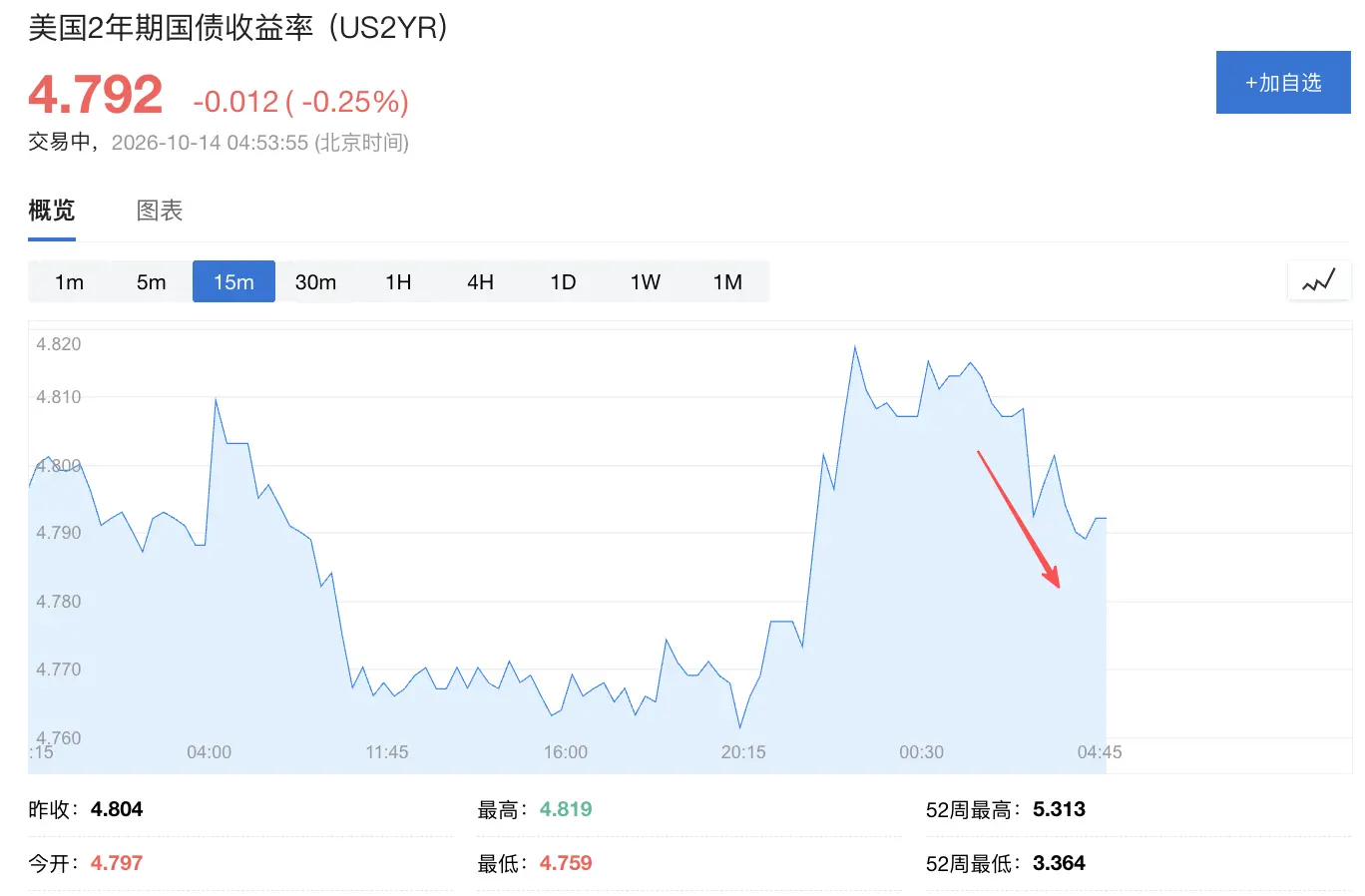
These remarks align with the tone of several recent Federal Reserve officials, but internal divisions still exist—some officials still lean towards another rate hike within the year. Bowman's statement helps shape market expectations: the likelihood of the Fed acting urgently at the policy meeting on October 27-28 is reduced, and the subsequent policy path depends on the upcoming inflation data.
No Urgency for Rate Hikes, Wait-and-See is the Current Tone
The Fed's monetary policy meeting in September decided to raise interest rates by 25 basis points, adjusting the federal funds rate target range to 3.75% to 4.00%. Bowman stated on Wednesday that after this, the Fed's decision-makers need time to understand how the effects of the rate hike are transmitted through the economy.
Bowman said, "I do not currently feel any urgency to take further action; we indeed need to take some time to understand how the situation will evolve." She added, "Before taking more action, we have time to wait and observe how financial conditions evolve."
Bowman emphasized that policy decisions should be based on a comprehensive assessment of all data while remaining vigilant to risks.
When asked whether her stance differs from the Fed's median forecast (which anticipates one more rate hike this year), Bowman reiterated that decision-makers should first assess the impact of the September rate hike before determining whether further action is necessary.
Internal Divisions at the Fed, Expectations for Another Rate Hike This Year Remain
Although Bowman’s wording is cautious, other officials have a clearer stance on another rate hike.
Reportedly, on Tuesday, the Fed's "third-in-command," New York Fed President John Williams, stated that another rate hike this year may be appropriate, saying, "I have not changed my view that another rate hike may be necessary," but he currently believes that no further hikes will be needed after 2027.
Earlier this month, the Fed's "second-in-command," Vice Chair Philip Jefferson, indicated that officials may need more time to decide whether to raise rates again. Boston Fed President Susan Collins stated on Tuesday that she believes the Fed needs to raise rates again before the end of the year to curb high inflation.
The statements from several officials come on the eve of the aforementioned policy meeting, with the September CPI data released that day becoming an important reference for the Fed's decision-making.
Reportedly, Natixis Chief U.S. Economist Christopher Hodge expects the core inflation data for September CPI to be slightly below market consensus expectations. Hodge predicts that the last rate hike will occur in December rather than October, unless the core CPI month-over-month reading reaches an unusually strong level of about 0.4%.
Financial Regulation: Calls for Reform of Post-2008 Crisis Rules
In addition to monetary policy, Bowman also expressed systematic views on financial regulation on Wednesday.
She pointed out that some regulatory rules enacted after the 2008 financial crisis have critical issues, pushing a large number of financial activities out of the formal financial system, and regulatory measures such as capital requirements have constrained growth to some extent. "We hope to pull some of that back," she said.
Bowman positions herself as a pragmatist, stating that we should look forward rather than backward to address the existing challenges in financial industry regulation.
She also called for a "comprehensive restructuring" of the Fed's internal regulatory system to improve regulatory effectiveness and enhance accountability mechanisms. This call stems from her commissioning of a special review of the 2023 collapse of Silicon Valley Bank.
AI and Data Centers: New Topics in Bank Regulation
Bowman also expressed concerns about the impact of artificial intelligence on financial regulation. She stated that cutting-edge AI models pose cybersecurity risks to critical infrastructure, which is an issue that regulators need to seriously consider.
At the same time, she noted that the capital demands arising from data center construction are also worthy of attention. She said, "We must consider where this funding comes from," emphasizing the need to ensure sufficient capital to support future economic development.
Nevertheless, Bowman stated that allowing banks to participate in innovation is equally important. The Fed is exploring how to integrate AI into the regulatory framework, including assessing how banks use AI and the potential applications of AI in areas such as fraud detection.

 Risk warning