Scan to download
BTC $61,487.47 -2.24%
ETH $1,643.80 -1.85%
BNB $569.61 -1.74%
XRP $1.08 -2.00%
SOL $68.92 -1.47%
TRX $0.3297 +0.25%
DOGE $0.0770 -2.74%
ADA $0.1499 -1.71%
BCH $194.22 -0.63%
LINK $7.50 -1.89%
HYPE $63.27 +1.70%
AAVE $83.96 +16.73%
SUI $0.6909 -2.49%
XLM $0.1877 -2.68%
ZEC $414.10 -1.40%
BTC $61,487.47 -2.24%
ETH $1,643.80 -1.85%
BNB $569.61 -1.74%
XRP $1.08 -2.00%
SOL $68.92 -1.47%
TRX $0.3297 +0.25%
DOGE $0.0770 -2.74%
ADA $0.1499 -1.71%
BCH $194.22 -0.63%
LINK $7.50 -1.89%
HYPE $63.27 +1.70%
AAVE $83.96 +16.73%
SUI $0.6909 -2.49%
XLM $0.1877 -2.68%
ZEC $414.10 -1.40%

senator

All
Article
Flash

Democratic senators in the U.S. are calling for a hearing on the UAE's $500 million investment in Trump's cryptocurrency project, accusing it of policy favoritism

On June 23, five Democratic senators from the U.S. Senate, including Elizabeth Warren and Richard Blumenthal, jointly sent a letter requesting multiple Senate committees to hold hearings immediately regarding the $500 million investment by UAE officials in the Trump family's cryptocurrency project WLFI, to investigate whether this investment influenced the Trump administration's subsequent policy decisions towards the UAE.According to the letter, an agent for a member of the Abu Dhabi royal family signed an agreement with the Trump family to acquire a 49% stake in WLFI for $500 million, with the agreement completed four days before Trump's inauguration. The foreign buyer prepaid $218 million to entities associated with the Trump family and Middle East chief diplomat Steve Witkoff. The deal was reportedly endorsed by UAE National Security Advisor Sheikh Tahnoon bin Zayed Al Nahyan, and the senators described this move as "unprecedented in U.S. political history."More concerning is the policy direction following the completion of the deal. The letter lists a series of decisions made by the Trump administration within months of the agreement that were clearly favorable to the UAE: approval of $1.4 billion in arms sales to the UAE; the Treasury Department establishing a "known investor pilot" program, which opened the green light for a fast-track approval process for the UAE that had long been lobbied for by CFIUS; and the Commerce Department lifting chip export restrictions from the Biden era, authorizing UAE AI company G42 to acquire 35,000 Nvidia Blackwell chips, with a transaction amount exceeding $1 billion. However, U.S. intelligence officials reportedly found that G42 had provided U.S. technology that could enhance missile capabilities to China.The senators demanded that Trump administration officials "explain under oath when they became aware of the payments to the president and his chief regional diplomat's family," and provide clarification on how to restore public trust. Currently, neither WLFI nor the UAE government has responded to this matter.

Bipartisan senators urge the U.S. Treasury to maintain state-level stablecoin regulatory authority under the GENIUS Act

A bipartisan group of senators led by Cynthia Lummis has written to U.S. Treasury Secretary Scott Bessent, requesting that the Treasury maintain states' regulatory authority over certain stablecoin issuers when formulating implementation rules for the GENIUS stablecoin bill. The GENIUS Act was signed into law last year, establishing a federal regulatory framework for stablecoins in the United States, requiring that stablecoins be fully backed by U.S. dollars or similar high-liquidity assets, and mandating that issuers with a market capitalization exceeding $50 billion undergo annual audits, while also setting rules for offshore issuance.The bill allows stablecoin issuers with a market capitalization of no more than $10 billion to be regulated at the state level, as long as the relevant state regulatory systems are "substantially similar" to federal requirements. The senators believe that the rules previously proposed by the Treasury do not clearly outline the timeline and standards for state regulatory system applications, reviews, and certifications, creating uncertainty for the states. The letter points out that there are significant differences in legislative cycles across states, with some states even adopting a biennial legislative cycle, thus requiring a flexible and continuously open certification mechanism to ensure that states can apply for certification when demand arises, rather than being constrained by timing mismatches that limit innovation and competition.

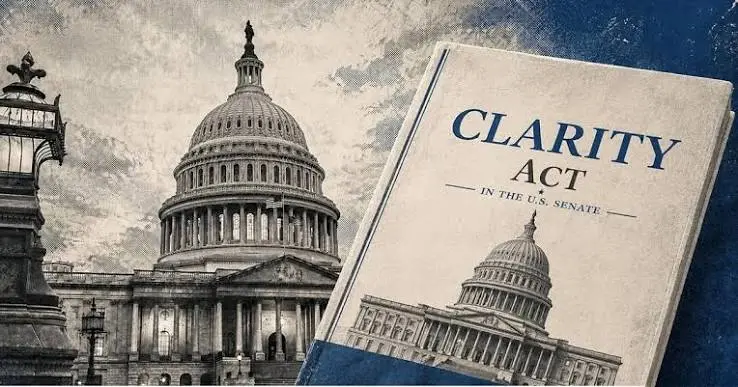
The "CLARITY Act" has entered the full voting stage in the Senate and still requires the support of at least 7 Democratic senators

The CLARITY Act has been reviewed by the U.S. Senate Banking Committee today and will next enter the full Senate voting stage.According to Mars Finance, the market is optimistic about the completion of the legislation this year, with the success probability predicted by the market Polymarket exceeding 70%. However, the bill must first pass the critical procedural threshold of the "motion to end debate," which requires at least 60 votes in favor from the 100 senators; otherwise, it may face indefinite delays.Reports indicate that two Democratic senators have explicitly crossed party lines to support the bill, and all 51 Republican senators are expected to vote in favor. Therefore, at least 7 Democratic senators' support is still needed to advance the bill to the final voting stage.In addition, the CLARITY Act will need to be integrated with the version from the Senate Agriculture Committee. The Banking Committee version mainly involves the SEC regulatory framework, securities classification, trading platform registration, and DeFi protection; the Agriculture Committee version focuses on CFTC regulation, digital commodity spot and derivatives markets, among other areas. The final unified text will be submitted for Trump’s signature after being voted on by both houses.Previous news: The U.S. Senate Banking Committee passed the CLARITY Act with a vote result of 15:9.
app_icon
ChainCatcher Building the Web3 world with innovations.