BTC $84,330.89 +0.50%
ETH $2,693.57 +0.27%
BNB $771.32 -0.29%
XRP $1.51 -2.87%
SOL $120.30 -0.08%
TRX $0.3331 -1.25%
DOGE $0.0958 -2.00%
ADA $0.2510 -1.83%
BCH $331.63 -1.49%
LINK $14.11 -0.28%
HYPE $93.44 +1.75%
AAVE $154.56 +0.27%
SUI $1.15 -0.13%
XLM $0.2137 -2.03%
ZEC $1,637.53 +6.83%
AAPL $340.35 -0.19%
AMZN $249.67 +0.00%
GOOGL $343.22 +0.02%
MSFT $517.47 -0.04%
META $747.23 +0.32%
NVDA $224.47 +0.01%
TSLA $372.23 +0.22%
SNDK $1,770.15 -0.02%
INTC $123.71 +0.95%
SPCX $148.59 +0.04%
MU $1,090.13 +0.92%
AMD $628.91 +0.02%
BTC $84,330.89 +0.50%
ETH $2,693.57 +0.27%
BNB $771.32 -0.29%
XRP $1.51 -2.87%
SOL $120.30 -0.08%
TRX $0.3331 -1.25%
DOGE $0.0958 -2.00%
ADA $0.2510 -1.83%
BCH $331.63 -1.49%
LINK $14.11 -0.28%
HYPE $93.44 +1.75%
AAVE $154.56 +0.27%
SUI $1.15 -0.13%
XLM $0.2137 -2.03%
ZEC $1,637.53 +6.83%
AAPL $340.35 -0.19%
AMZN $249.67 +0.00%
GOOGL $343.22 +0.02%
MSFT $517.47 -0.04%
META $747.23 +0.32%
NVDA $224.47 +0.01%
TSLA $372.23 +0.22%
SNDK $1,770.15 -0.02%
INTC $123.71 +0.95%
SPCX $148.59 +0.04%
MU $1,090.13 +0.92%
AMD $628.91 +0.02%

senate

All
Article
Flash

first_img Democratic members of the U.S. Senate Banking Committee call for a public hearing on prediction markets

Democratic members of the U.S. Senate Banking Committee sent a letter to the committee's chairman, Republican Senator Tim Scott, calling for a congressional hearing on prediction markets. The Democrats stated in the letter that the committee has a "critical oversight responsibility" in regulating prediction markets and emphasized that Congress should examine prediction markets through public hearings on a bipartisan basis, rather than in closed-door roundtable meetings limited to Republicans and industry-friendly discussions. Senators including Elizabeth Warren signed the letter.On the same day, Republican members of the Senate Banking Committee met with Tarek Mansour, CEO of the prediction market platform Kalshi. Scott stated in a statement to The Block that he convened Republican lawmakers to meet with Kalshi to better understand the opportunities and challenges presented by securities-linked products. The two sides discussed keeping innovation within the United States, how investors use these products, protecting retail investors, and regulatory issues that Congress should address. Kalshi did not immediately respond to a request for comment.Currently, the U.S. Commodity Futures Trading Commission (CFTC) advocates for a leading role in the regulation of prediction markets but faces opposition from various states, which claim jurisdiction over sports event contracts. The Senate Banking Committee, on the other hand, has jurisdiction over the SEC and is responsible for regulating "securities-linked products" related to prediction markets. Democrats pointed out that the bets offered by such products, which are linked to company performance metrics, may fall under the SEC's regulatory scope. It has been reported that Cboe Global Markets is seeking SEC approval for its listing of "all-or-nothing options" linked to company earnings results.

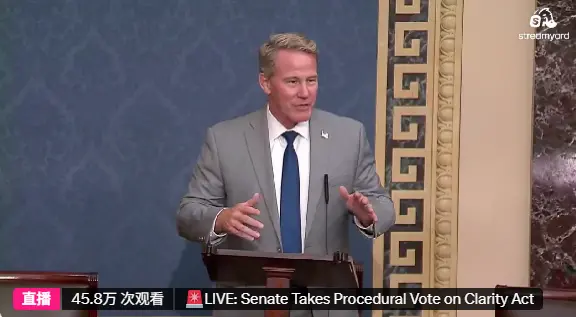
The U.S. Senate is about to conduct a procedural vote on the CLARITY Act, with a threshold of 60 votes

The U.S. Senate will conduct a procedural vote on the Digital Asset Market Clarity Act (referred to as the CLARITY Act). At 2:15 AM Beijing time on September 16, senators will decide whether to end the debate on the motion to enter the bill's review process, with a threshold of 60 votes. If the vote passes, the bill will then enter full Senate debate, amendments, and subsequent final voting, which does not equate to the bill being passed directly that night, nor does it mean it will take effect immediately.To garner bipartisan support, Senate Republicans accepted 126 substantive amendments proposed by Democrats in the final draft. The new text includes stricter ethical provisions, granting state attorneys general a clearer enforcement role; it also gives the Secretary of the Treasury the authority to intervene against potential deposit outflows triggered by payment stablecoins, and revises developer-related provisions to reduce the risk of decentralized infrastructure developers being classified as money transmission entities. Democrats are concerned that the Trump family's cryptocurrency business may create conflicts of interest, with some lawmakers hoping to add constraints such as asset divestiture or blind trusts; moderate senators like Warner and Gallego still hope to push for more amendments. Some Republican lawmakers are also under pressure from the banking industry, fearing that accounts with yield attributes linked to stablecoins could siphon off deposits from community banks.

first_img U.S. Senators Discuss Requirement for AI Companies to Fulfill Duty of Care

According to a report by Reuters, U.S. Senate negotiators are discussing legislation that would require artificial intelligence companies to demonstrate that they are taking reasonable precautions to prevent their tools from causing harm. The proposal aims to grant the U.S. Secretary of Commerce the authority to require developers to provide proof of reasonable steps taken to prevent harm, referred to as "duty of care," and to authorize the dispatch of government auditors to test relevant products. Reuters was unable to immediately determine what constitutes "reasonable," and the related legislation is still under discussion.Even if Congress passes the measure, its prospects of becoming law still face significant resistance. U.S. President Donald Trump stated on Monday that existing authorities are sufficient to regulate and prosecute technology companies, suggesting that he would not sign a bill that sets new rules for artificial intelligence. Senate Majority Leader John Thune, Senate Commerce Committee Chairman Ted Cruz, and Democratic Senator Amy Klobuchar, who is involved in the negotiations, are discussing the proposal. Thune told reporters on Monday that Congress could set safeguards against more significant threats without compromising the U.S.'s leading position in the artificial intelligence race.Klobuchar stated in a statement that she is continuing to push for bipartisan legislation to oversee the greatest risks posed by artificial intelligence models, including requiring developers to work with government experts to validate and test models to ensure safety. Senior Democratic member of the Commerce Committee Maria Cantwell is also involved in the discussions. Reuters reported on Friday that negotiators are also discussing the possibility that if the government determines that certain artificial intelligence models are unsafe and wishes to prevent their release, it could be brought to federal court, where companies could challenge that decision. The portion of the measure involving federal courts would also prevent states from enforcing their own laws regarding specific risks associated with artificial intelligence models.

first_img U.S. Treasury Secretary Janet Yellen strongly urged the Senate to pass the Clarity Act

U.S. Treasury Secretary Scott Bessent posted on the X platform, strongly urging the Senate to advance the legislative process of the cryptocurrency Clarity Act after the August recess. He stated that the bill would prevent "bad actors" from exploiting important digital asset technologies and called on all parties to stay at the negotiating table, agree to procedural motions, and continue the legislative process.Bessent warned that failing to pass the bill would send a troubling signal to allies and adversaries, indicating that the U.S. is unwilling to lead the future of digital assets and is willing to forgo national security tools to combat the abuse of digital assets. In July of this year, Bessent stated that if one wants to stand on the side of "American exceptionalism," the Clarity Act must be passed, citing remarks from Satoshi Nakamoto.The Clarity Act was passed by the House last year and aims to establish a regulatory framework that clearly delineates the regulatory classification of digital assets as securities, commodities, or stablecoins. The bill has stalled this year due to disagreements between banking lobbyists and cryptocurrency companies over stablecoin revenue issues. A new draft in July prohibits government officials from promoting cryptocurrencies or profiting from them, but some Democrats still believe the bill is inadequate and demand amendments. President Trump also urged lawmakers to push the bill through.

Coinbase CEO: The CLARITY Act is expected to receive 60 votes of support in the Senate on September 15

According to CoinDesk, Coinbase CEO Brian Armstrong stated that the U.S. "Digital Asset Market Structure Clarification Act" (CLARITY Act) is expected to receive over 60 votes of support in the U.S. Senate on September 15 and is confident about passing the first key procedural vote after returning to Congress.Brian Armstrong previously mentioned that the CLARITY Act has entered its final advancement stage, and the Senate procedural vote requires 60 votes of support to push the bill forward. The bill aims to establish a regulatory framework for digital assets in the U.S., clarifying the division of responsibilities between the U.S. Securities and Exchange Commission (SEC) and the Commodity Futures Trading Commission (CFTC) in the regulation of crypto assets. Armstrong believes that the clarification of U.S. crypto industry regulation is approaching, and whether the CLARITY Act ultimately passes or regulatory agencies advance through administrative rules, the market will welcome a clearer regulatory environment.Previously, U.S. President Trump also called on Congress to push the CLARITY Act through, believing that the bill is significant for establishing a regulatory system for digital assets and enhancing the competitiveness of the U.S. crypto industry. reuters.com However, the bill still faces controversy from some lawmakers regarding issues such as conflicts of interest and stablecoin regulation, and whether it can ultimately be successfully implemented still depends on subsequent negotiations in the Senate.
app_icon
ChainCatcher Building the Web3 world with innovations.