BTC $63,296.75 +0.39%
ETH $1,897.65 +0.83%
BNB $603.91 -0.36%
XRP $1.00 -0.09%
SOL $75.42 -0.16%
TRX $0.3318 +0.31%
DOGE $0.0700 +0.36%
ADA $0.1770 +0.05%
BCH $204.54 +0.56%
LINK $9.50 +0.69%
HYPE $58.84 +3.17%
AAVE $86.68 +0.35%
SUI $0.6783 +0.24%
XLM $0.1582 +0.77%
ZEC $492.27 +1.23%
BTC $63,296.75 +0.39%
ETH $1,897.65 +0.83%
BNB $603.91 -0.36%
XRP $1.00 -0.09%
SOL $75.42 -0.16%
TRX $0.3318 +0.31%
DOGE $0.0700 +0.36%
ADA $0.1770 +0.05%
BCH $204.54 +0.56%
LINK $9.50 +0.69%
HYPE $58.84 +3.17%
AAVE $86.68 +0.35%
SUI $0.6783 +0.24%
XLM $0.1582 +0.77%
ZEC $492.27 +1.23%

supplier

All
Article
Flash

hot_img Counterpoint: If the United States bans imports of Chinese optical modules, it will backfire on domestic cloud vendors rather than just Chinese suppliers

According to Counterpoint Research analysis, if the proposed import ban on Chinese optical modules by the Federal Communications Commission (FCC) in the United States is implemented, it will primarily impact American cloud providers rather than Chinese suppliers. InnoLight leads the global data center optical module revenue with approximately 27% market share, while Coherent ranks second with about 17%. Chinese manufacturers collectively account for about two-thirds of the global unit supply and approximately 60% of the optical communication module revenue.The analysis points out that Western suppliers like Coherent and Lumentum lack sufficient cleanroom capacity, automated packaging infrastructure, and yield scale in the short term, making it impossible to fill the capacity gap left by Chinese manufacturers within 12-24 months. This could lead to delays in AI cluster deployments by several quarters and increase material costs for cloud providers. At the same time, Chinese module manufacturers rely on high-end 800G/1.6T module revenue from North American hyperscale customers for over 90%, but have achieved partial capacity relocation by establishing factories in Thailand.Counterpoint emphasizes that the optical module supply chain is a highly interdependent system. Chinese manufacturers heavily procure DSP chips from Broadcom and Marvell, as well as lasers and optical chips from Lumentum, Coherent, and Mitsubishi Electric. A forced separation would disrupt the entire ecosystem.

hot_img TrendForce: AI demand drives Japanese and Korean MLCC suppliers to achieve the highest shipments in June in five years, with consumer-grade order overflow boosting prices from Taiwanese and Chinese manufacturers

According to the latest survey by TrendForce, in June, the top three MLCC suppliers in Japan and South Korea (Murata, Samsung Electro-Mechanics, Taiyo Yuden) achieved a monthly shipment volume that reached a nearly five-year high, with 140 billion, 98 billion, and 40 billion units respectively, and the growth momentum continued into July. AI applications are the main driving force, with CSP manufacturers maintaining strong procurement demand for self-developed ASIC platforms such as Google TPU and AWS Trainium, driving continuous growth in demand for high-capacity, low-voltage, small-sized MLCCs.At the same time, Japanese and South Korean suppliers are accelerating the shift of production capacity from consumer-grade X5R to high-end X6S/X7R specifications, resulting in a severe squeeze on the production capacity of mid-to-high capacity (1µF-22µF) consumer-grade MLCCs, with mainstream inventory days generally falling below 30 days. The overflow effect of production capacity has led channels, agents, and second- and third-tier customers to urgently pull goods, significantly increasing order visibility for Taiwanese and mainland suppliers, leading to rising prices, with agents raising prices by an average of 20-25%, and spot market prices have soared to 2-3 times the original price. TrendForce pointed out that the consumer-grade MLCC market currently shows a structural mismatch of "weak end demand, strong channel pricing."

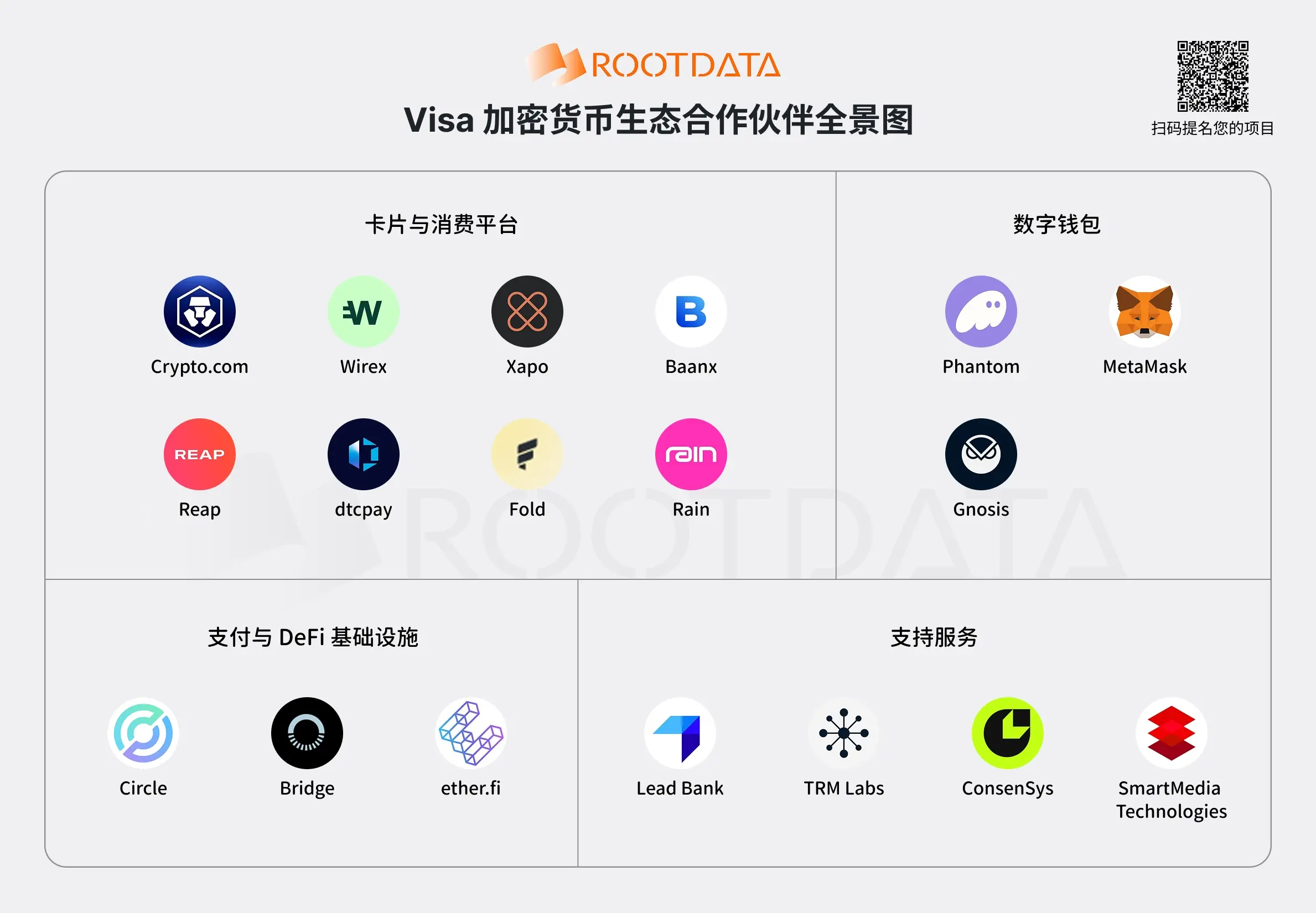
Illustration of 18 Web3 suppliers collaborating with Visa: from infrastructure to payment closure

The Web3 asset data platform RootData released a network map of Visa's business partners in the cryptocurrency field on X, systematically outlining its complete ecological layout from underlying infrastructure to end applications.Structurally, Visa has formed a "three-layer synergy" model: the upstream is provided by stablecoin issuers like Circle, offering settlement infrastructure, along with risk control and compliance service providers like TRM Labs; the middle layer connects on-chain and traditional finance through bridges and banking institutions; the downstream is handled by wallet and card issuing platforms, including MetaMask, Wirex, etc., facilitating actual payment scenarios for users.This layout reflects that the cryptocurrency industry is accelerating its integration into the traditional payment system, with the combination of "stablecoin settlement + compliance risk control + card network" becoming the mainstream path. 【View Visa Crypto Partner Network Compilation (continuously updated)】RootData stated that it will continue to track and open more project business relationship disclosure channels. For cryptocurrency projects, actively showcasing partners and business networks is becoming an important way to enhance transparency and market trust. Web3 project parties are welcome to claim data and join the RootData Alliances Hub TG group to maintain business alliance data, match BD partners, and explore ecological cooperation together!
Illustration of 18 Web3 suppliers collaborating with Visa: from infrastructure to payment closure
app_icon
ChainCatcher Building the Web3 world with innovations.